
Therapy Across Party Lines

Helping mental health professionals stay client-centered in a socially divided world
How can sociopolitical identity impact the therapeutic relationship?
The therapist's sociopolitical values can influence diagnosis, intervention, and the therapeutic relationship
Differences in sociopolitical values can bias clinical judgment and lead to negative outcomes in counseling and psychotherapy
Mental health professionals have far more non-religoius people when compared to the general population.
The most common mismatch between sociopolitical identities is between a liberal therapist and a conservative client.
There are many ways that sociopolitical content can enter the psychotherapy session. Exploring the client's sociopolitical identity and values provides rich terrain for enhancing the therapeutic alliance, yet challenges arise when the clinician's sociopolitical identity or values are at odds with those of the client. With rising political divisions and affective polarization, mental health providers can be derailed in their efforts to build meaningful trusting connections with their clients.
The impact of sociopolitical values on the therapeutic alliance is often under-discussed in education and clinical training. To help clinicians understand key aspects of this topic, we have presented two theoretical models supported by highly cited research. If the clinician becomes preoccupied with the client's political in-group, these theories can help them move beyond political parties and towards belief diversity.
*Adapted from Redding (2020), Sociopolitical Values: The Neglected Factor in Culturally Competent Psychotherapy
Nature & Nurture: A bio/psycho/social model of sociopolitical identity
Personality, shaped by genetics, temperament, and the social environment, can influence our politics. Liberals are found to be high in openness, whereas conservatives are high in conscientiousness.

With affective polarization, it becomes easy to fall into fear or anger, fixated on the political out-group. This personality model offers an individualized conceptualization of the client's sociopolitical identity that can distinguish them from the group. Notice also that this model is strength-based; neither political ideology is pathological or unfavorable. These qualities can help foster a cross-partisan therapeutic alliance.
Respecting your Client's sociopolitical values with belief diversity
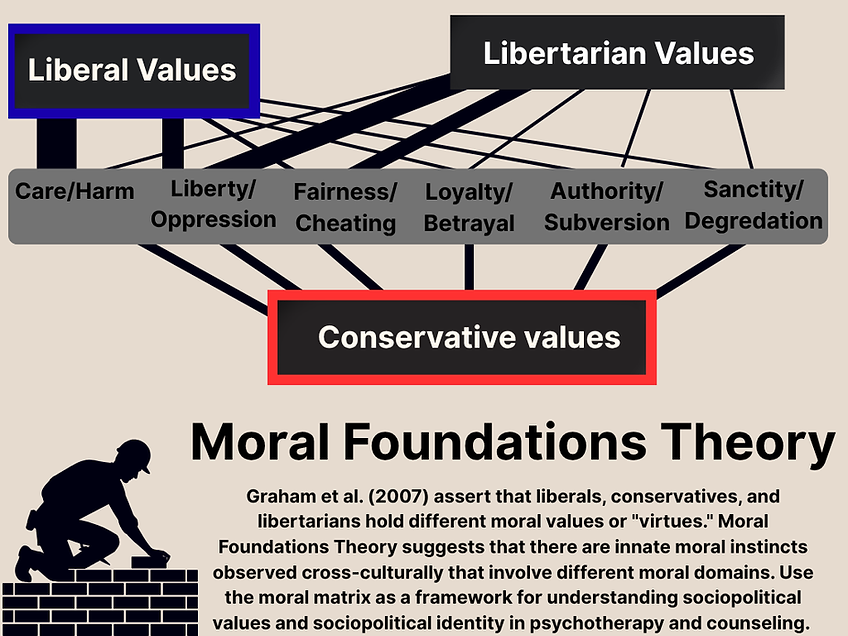
Liberals and conservatives have different moral values
.png)
We can move beyond thinking that people are "bad" or "wrong" when we better understand their value systems. Notice that liberals are strongly bound to the Care/Harm and Liberty/Oppression domains. People tend to care for others and avoid harming them through evolutionary mechanisms such as attachment bonding and empathy.
Liberals may have more difficulty understanding conservative values, which are more closely tied to loyalty, authority, and sanctity. This is not right or wrong, but rather a different makeup of moral values. This moral matrix can be useful for framing belief diversity when working with clients across the political spectrum.
*Adapted from Chapter Seven of Jonathan Haidt's The Righteous Mind: Why Good People are Divided by Politics and Religion
We developed the EMBRACE framework to further prepare therapists to work with politically diverse populations amid affective polarization.